

Validity Research · 2026
Cutout vs GymAware vs Vitruve
Smartphone-Based Barbell Velocity Tracking Compared With Linear Position Transducers
This study compares Cutout's computer vision-based velocity tracking against GymAware and Vitruve during free-weight bench press and back squat testing across light, moderate and heavy loading conditions.
Background
Velocity-based training (VBT) has become a widely adopted approach within strength and conditioning, enabling practitioners to quantify training intensity, fatigue, and neuromuscular performance through barbell velocity rather than relying solely on percentage-based loading prescriptions.
Traditionally, barbell velocity has been measured using linear position transducers (LPTs) such as GymAware and Vitruve. These devices attach directly to the barbell via a tethered cable and are considered highly reliable in both research and high-performance environments. However, they require dedicated hardware, physical attachment to the bar, and set-up time — limiting scalability across team settings or school-based environments.
Cutout uses computer vision and motion tracking to estimate barbell velocity without requiring physical attachment. The purpose of this study was to directly compare Cutout against GymAware and Vitruve to determine whether a smartphone-based system can produce practically comparable velocity outputs. Importantly, while both devices are considered accurate, GymAware is widely regarded as the gold standard among velocity-based training devices, making it a suitable benchmark for evaluating the practical validity of Cutout’s velocity estimates.
Results
Mean difference (m/s) between devices across bench press and back squat.
Bench Press
Cutout vs GymAware
Tightest pairing
0.011 m/s
Cutout vs Vitruve
0.031 m/s
GymAware vs Vitruve
0.042 m/s
Back Squat
Cutout vs GymAware
Tightest pairing
0.015 m/s
Cutout vs Vitruve
0.017 m/s
GymAware vs Vitruve
0.033 m/s
The largest discrepancy in both exercises was between GymAware and Vitruve — not between Cutout and either hardware device.
Key Findings
Cutout demonstrated close agreement with both GymAware and Vitruve across all loading conditions in bench press and back squat.
The mean difference between Cutout and GymAware for bench press was 0.011 m/s — the tightest pairing in the entire study.
Differences between Cutout and each LPT were consistently smaller than the differences observed between GymAware and Vitruve themselves.
Bland–Altman and residual analyses showed no substantial systematic drift across light, moderate, or heavy loads.
All inter-device differences remained predominantly within ±0.05 m/s across the observed velocity spectrum.
Cutout successfully captured the expected decline in velocity within sets, comparable to both reference devices.
Camera-based tracking required no attachment to the barbell, no tethered hardware, and no dedicated set-up time.
Methodology
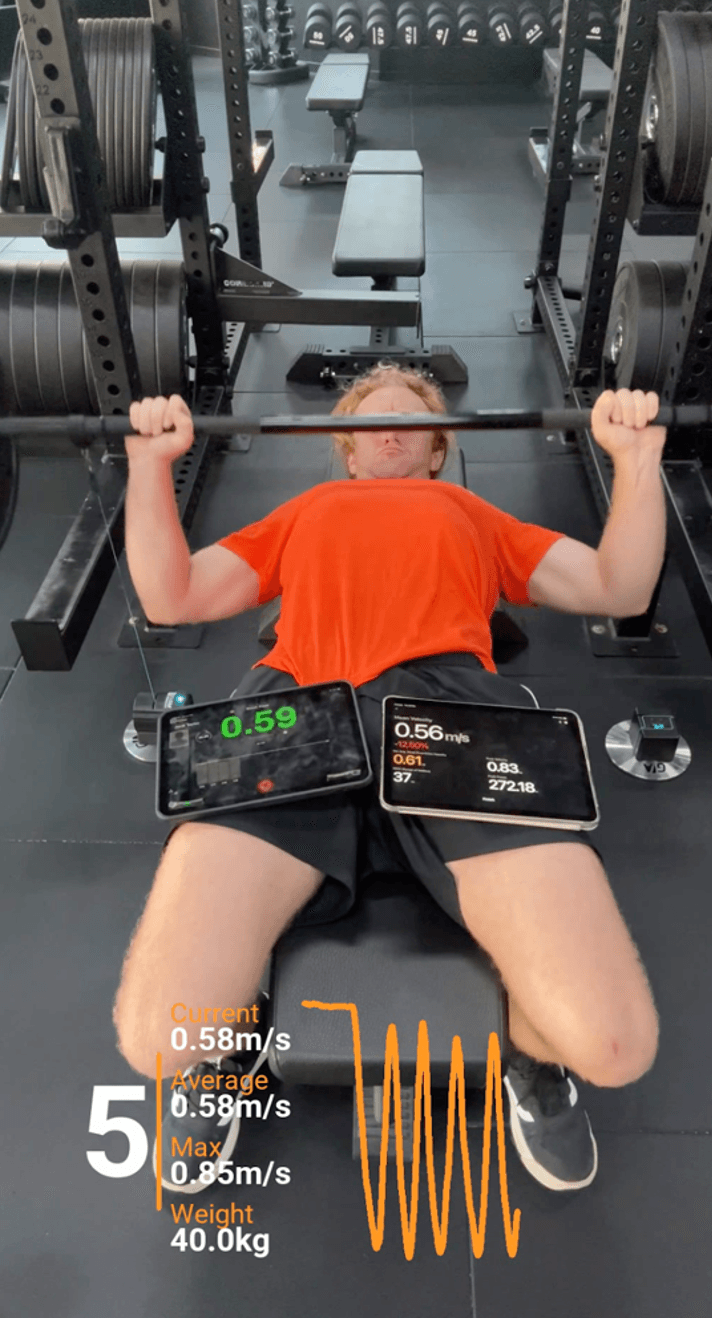
Two resistance-trained male participants completed sets of free-weight barbell back squats and bench press at light, moderate, and heavy intensities. Repetition ranges varied from three to over twenty reps per set.
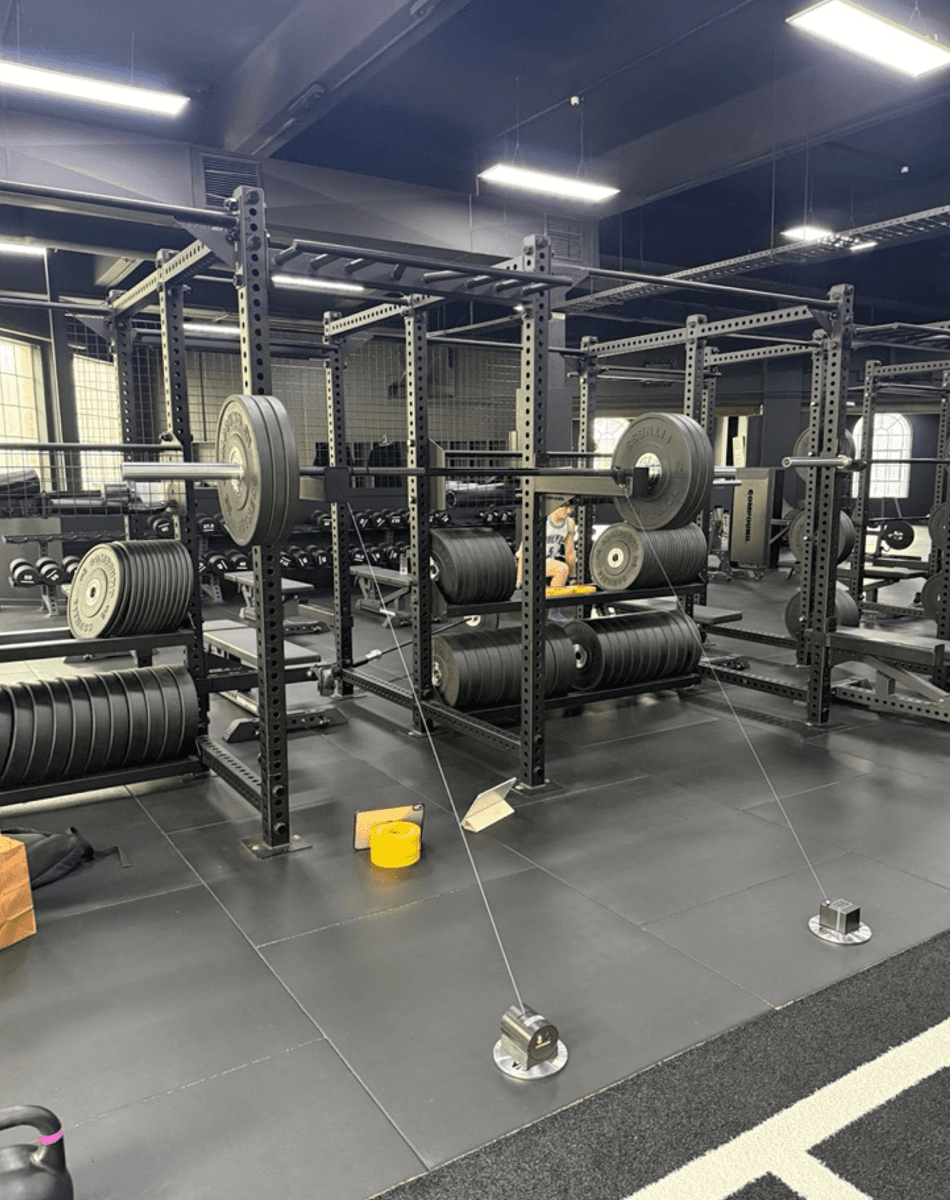
GymAware and Vitruve were attached to opposite sides of the barbell simultaneously using their standard tether systems. An iPhone running the Cutout application was mounted to the squat rack at a fixed angle to ensure consistent framing throughout all trials.
Real-time LPT outputs were displayed on iPads positioned within the camera field of view, enabling synchronised recording of athlete movement alongside both hardware device outputs. Mean concentric velocity was recorded on a repetition-by-repetition basis across all three systems.
Statistical analysis included descriptive statistics, mean difference calculations, Bland–Altman plots, and residual distribution analyses for each device pairing: Cutout vs GymAware, Cutout vs Vitruve, and GymAware vs Vitruve.
Same results.
A fraction of the cost.
Cutout performs comparably to devices that cost hundreds of times more — and requires no hardware at all.
GymAware
$2,800
one-time
Hardware device required
Tethered to barbell
Vitruve
$625
one-time
Hardware device required
Tethered to barbell
Cutout
$5
per month
No hardware needed
iPhone only
The GymAware upfront cost equals
46 years of Cutout
The Vitruve upfront cost equals
10 years of Cutout
Conclusion
Cutout produced mean concentric velocity outputs that were practically comparable to those obtained from GymAware and Vitruve during free-weight bench press and back squat. Discrepancies between Cutout and either hardware device were equal to or smaller than the discrepancies observed between GymAware and Vitruve themselves.
These findings support the use of smartphone-based computer vision tracking as a valid and scalable alternative to tethered linear position transducers for monitoring velocity-based training — particularly in school, team, and group training environments where hardware cost and set-up time are limiting factors.